

You've looked at all the benefits and risks of an induction, you understand the process and have decided that this is the best option for you. (If you are unsure, read my blog on Should I have an Induction HERE) Let's look at how you can have a positive and empowering induction of labour.
Common Fears and Disappointments around Induction of Labour and What can Help
Perhaps you were hoping to go into labour naturally, but your circumstances have changed, and an induction feels like the right path to take. It's totally normal to have mixed emotions at the same time.

Fear that Induction will be More Painful
It is true that an induced labour is more intense than a physiological one. However, being forewarned will help you prepare mentally and physically. Not preparing can increase anxiety, which will increase tension in your body and your pain perception.
What helps:
-
Understanding that pain is influenced by fear, your environment, support and coping tools, not just hormones
-
Learning about pain relief options in advance so you feel prepared, not anxious
-
Using breathing, relaxation, movement or hypnobirthing techniques where possible
-
Shifting your belief that choosing pain relief is not a failure, it’s a tool to help you cope
-
Having continuous, reassuring support from a trusted person like a doula or birth partner who knows you and understands birth.
Fear of Cascade of Interventions
A lot of women are concerned that an induction will lead to an instrumental or surgical birth.
What helps:
-
Asking about a step-by-step approach rather than rushing ahead
-
Requesting time between interventions when it’s safe to do so, to see if your body will take over the labour process
-
Understanding that intervention is not inevitable, and outcomes vary widely
-
Feeling informed about options if progress is slow
- Trying to change positions often, or keeping mobile, helps your baby navigate his/her way through the pelvic inlet and outlet.

Fear of Losing Control
Many women worry that once induction starts, decisions will have to be made quickly or without their full involvement or understanding.
What Helps:
- Understanding the process of induction and the choices you have at each stage
- Knowing that your consent is ongoing, not a once-off decision - stay engaged in the conversation
- Writing a simple induction-specific birth plan
- Agreeing on phrases with your birth partner, like “We’d like a moment to talk privately, please”
- Remember, you can ask why, what the options are, and what happens if we wait.
- Express what matters most to you.(connection, dignity, safety)
Disappointment of Not Going into Labour Naturally
Of course, this is going to be disappointing if you were really trusting labour would start spontaneously.
What Helps:
-
Allowing space to acknowledge and grieve that disappointment without guilt
-
Separating how labour started from how I felt during the birth
-
Reframing induction as support rather than failure
-
Talking openly about feelings rather than pushing them aside
-
Remembering that most positive birth memories come from feeling supported, not from spontaneity
Disappointment in feeling your body has failed
Your body has grown your baby, and sometimes the body needs a bit of help due to unforeseen circumstances.
What Helps:
What helps:
-
Understanding that many factors beyond control influence labour timing
-
Releasing the idea that bodies must behave in a certain way to be “successful”
-
Using language that is kind to yourself (e.g. my body needed support, not my body failed)
-
Hearing other induction stories that are positive and empowering
-
Gentle self-compassion - especially in late pregnancy, when emotions run high
Disappointments with Having a More Medical Setting
Maybe you were planning a homebirth, or birthing on the active birth unit, and now you're going to be in the labour ward. I have supported several clients where we have still created a beautiful, calming environment
What Helps:
What helps:
-
Making small changes that increase comfort (lighting, music, clothing)
-
Creating emotional safety through familiar voices and touch
-
Remembering that a clinical setting can still hold warmth, respect and humanity
-
Asking what flexibility exists around monitoring and movement
-
Focusing on connection with your baby, your partner, and yourself
Reframing Induction of Labour
Small adjustments to your thinking and language can have a huge impact subconsciously. For example, instead of thinking induction is something that happens to you, you can actively choose and participate in the process and all the decisions along the way.
If you've decided to go ahead with an induction, it is possible to feel empowered in confidently stating what you want each step of the way. You can draw up a plan where you decide how you want the induction to go. Understanding the induction procedures can help you make informed decisions. (This blog discusses the reasons, risks, and methods of induction.) Voicing your wishes and having them listened to and honoured will help make your birth a positive and special experience.
Making Informed Choices
You still have options and choices if an induction of labour has been recommended to you. Gathering all the information you can through reading, podcasts, and childbirth education classes will all help you in making an informed decision.
If an induction has been recommended and taken you completely by surprise, ask your midwife or consultant if you have time to decide, and what other alternatives are available.
What Questions Should I Ask My Midwife?
Understanding your individual circumstances, as opposed to generalised care, will give you personal and balanced information to help you weigh up the answers with your own personal values.
- Why is an induction being offered?
- What is the absolute risk of this happening?
- How often have you seen this happen?
- Is this a recommendation you make for everyone?
- What are the risks of having and not having the induction?
- What are the benefits of having/not having the induction?
- Are there any alternatives, e.g., extra monitoring?
- What if we do nothing, or wait a day/week?
Creating an Induction of Labour Birth Plan
If you don't know your options, you don't have any!
~A Good Birth, A Safe Birth~
Plans matter. They help bring clarity and help refine what is important for YOU. They express your expectations and what you want to protect.
Your midwife/consultant must give you ALL the information necessary for your individual circumstances, so you can make an informed decision. At each stage of the induction process, there are options which you need to be aware of, eg. extra monitoring, vaginal examinations, cannula placement, etc. Know your options BEFORE you go in for your labour induction so you and your partner can advocate for what you want.
Ripening & Stretching Your Cervix
- Would you like to start with a membrane sweep before using stretching procedures?
- Would you prefer a mechanical device (e.g. Foley Balloon) over a prostaglandin?
- Consider your mobility: maybe you would like to walk outside, or go home after the procedure.
- What sort of pain relief are you willing to try?
Rupture of Membranes & Starting Contractions
When your cervix has dilated, the next step is often breaking the amniotic sac around your baby, and then starting the oxytocin drip to bring on or increase your contractions.
Consider the following options:
- When would you like your waters broken? Before or after contractions start?
- Would you like to wait and see if your body goes into labour after your waters have been broken?
- Do you want to be mobile after they break your waters?
- Where would you like the placement of the drip? (non-dominant hand?)
- Would you like cordless monitoring so you can move around the room?
- What pain medication would you like?
- Would you like the staff to tell you what options you have, or would you rather ask if/when needed?
- How would you like your environment?
- Do you want the monitor sound turned down/off?
- How do you feel about vaginal examinations?
- Do you want the syntocynon turned down or off when you are fully dilated?
- What position might you want to be in to birth your baby? eg on your side, off your back, or on all fours
Postnatal Considerations
There are still many options available after your baby has been born. How your child is welcomed and introduced to the world can be controlled by you.
- If you don't know the baby's sex, who do you want to announce it?
- Would you like immediate skin-to-skin?
- Would you like optimal cord clamping?
- Do you want to use a cord tie instead of the plastic clamp?
- Are you interested in seeing your placenta?
- Do you want to initiate breastfeeding as soon as possible?
- If baby needs additional support, do you or your partner want to accompany them to the special baby unit?
- Do you want your baby to have your expressed milk, donor milk or formula?
If Your Birth Plan Unravels
Sometimes plans deviate, often out of necessity. Flexibility and adaptation are key to staying engaged and present. Now is not the time to resign and disengage if you want a positive and empowering experience. Resignation can look or sound like:
- Emotionally withdrawing from your birth
- Handing over your autonomy and sovereignty, eg. "Whatever you think is best," or " I just want this to be over."
Staying emotionally present is being part of the conversation:
- Ask questions
- Make sure you understand ALL your options and the knock-on effect this could have
- Vocalise what matters most to you (safety, dignity, respect)
Rest, Nourishment & Support

I want you to understand that an induction of labour is by no means a quick process. It can take days before you meet your baby. Your body is being medically forced into labour before it's ready. Be ready for the long haul, especially if you are not able to return home before labour becomes established.
If you're in the induction bay, along with other women in different stages of their labour, it can be noisy. If you've been called in to start your induction through the night, ask if you can schedule it for the morning, or be prepared with noise-reducing earphones, relaxing music, and some home comforts like your own blanket or pillow. Rest at this stage (especially during the night) will preserve your energy for when you really need it.
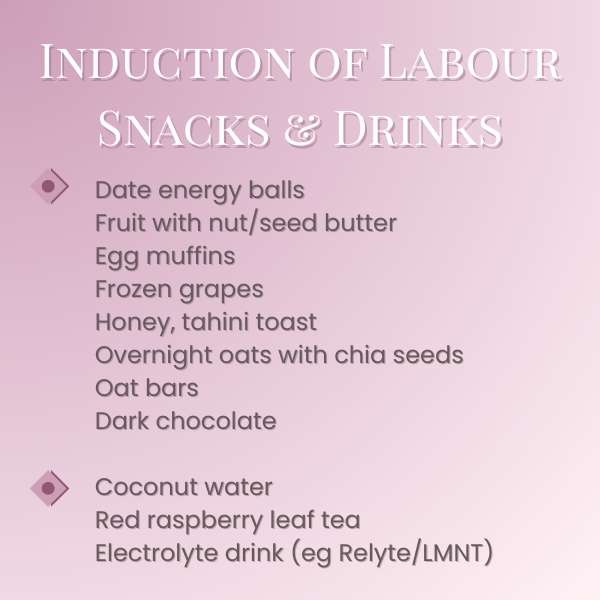
Make sure to bring in your own energy-rich, nutrient-dense snacks. Labour has been compared to running a marathon...never mind that a marathon is only 3 hours, and labour can be anything from 5-20 hours. For muscles to work effectively during times of intensity, they need energy. The uterus is made up of 3 layers of muscle tissue; therefore, it needs energy.
Plan on packing small, easy-to-eat snacks that are high in fibre with added protein. Pack foods that are not only nourishing, but comforting too (think boosting your oxytocin)
Don't forget to keep yourself hydrated, not only with water, but with drinks that are high in vitamins, minerals and trace elements.
Eating and drinking during an Induction
Some women are told they are not allowed to eat or drink during an induction. This is a common hospital policy implemented to prevent (the unlikely) aspiration if the woman vomits during a general anaesthetic. If a caesarean is needed, the use of spinal blocks or epidurals is more common than a general anaesthetic.
According to a Cochrane meta-analysis of over 3000 women, results showed ZERO increased risk, or any medical benefit from eating during labour.
Creating the Right Environment for an Induction of Labour
The very shy hormone, oxytocin, drives labour. No matter where you are in your induction, even if you're on the synthetic oxytocin drip, creating a calm, safe environment, free from interruptions, will help your labour progress.
Are there any home comforts you can bring with you that will help oxytocin flow? Think:
- Favourite music
- Low lighting
- favourite scent eg. aromatherapy oils, your hubby/partner's t-shirt
- Your cosy blanket or dressing gown
- A photo of your favourite holiday spot, or a family picture
- Your most comforting food
If you want to stay mobile or active during labour, ask for soft mats, a birth ball, a peanut ball, or access to water, using the shower, bath, or bath/birth pool.
The Role of Your Support Team During an Induction
Your support team play a vital role during an induction of labour. While you focus inward on your body, your breathing, and your baby, your birth partners help to protect your physical, emotional, and sensory environment.
Before your induction starts, it can be helpful to reflect on what helps you feel safe, calm, and supported. What works for one woman may or may not work for you, as you are unique, with your own unique needs.
You might want to consider:
-
Do you find comfort in touch, such as hand-holding, massage, or counter-pressure?
-
Do words of encouragement help you stay focused and grounded, or do you prefer a quiet presence?
-
How important is it to you that your support team are steady, confident, and reassuring?
-
Would you like your birth partner or doula to speak up for you, or do you feel comfortable doing that yourself?
Sharing these preferences in advance helps your support people understand how best to support you when things feel intense or when decision-making feels harder.
Advocacy: Having Someone Hold the Space for You
During an induction of labour, there may be moments when decisions are offered quickly, information feels overwhelming, or your energy is needed elsewhere. This is where advocacy becomes especially important.
Advocacy does not mean being difficult or refusing care. It means:
-
Ensuring you are given clear, balanced information
-
Supporting your right to ask questions and take time
-
Helping your wishes be heard, respected, and revisited if needed
A trusted birth partner, or an experienced doula, can act as a calm, respectful voice on your behalf, slowing things down if there is no emergency, asking questions, clarifying options, and gently reminding staff of your preferences if you are deeply focused on your labour.
They might:
-
Ask for explanations in plain language
-
Request time to think or talk privately
-
Check whether there are alternatives available
-
Refer back to your birth preferences or birth plan
-
Help ensure consent is informed and unhurried
- Check in with you and your instinct
This kind of advocacy helps protect your sense of autonomy and emotional safety, which can be just as important as physical care during labour.
I have created a FREE advocacy cheat sheet that you can download right now:

Navigating Induction of Labour Methods
Your body does respond differently to an induction of labour because your body hasn't built up the cocktail of hormones, softened or thinned out your cervix, or started the positive feedback loop between your brain and uterus.
Here are some considerations to have with your medical team:
- Are there methods of induction that are gentler than others?
- Can you choose which method of induction to start with?
- Can I ask for breaks between each step?
REMEMBER: Consent needs to be ongoing.
Comfort and Pain Relief During an Induced Labour
Ask any woman who has had a spontaneous, natural birth and an induction, to compare the two, and she will tell you that her induction of labour was way more intense than her natural birth.
Knowing what medical and non-medical options are available to you beforehand can help you prepare.
Doulas are really fantastic in this area of pain-relief options, from knowing what's available to providing hands-on support.
Having a caring and supportive birth partner who understands what is important to you and helps to protect what matters most to you is invaluable.

Labour is powerful, intense, hard work, and yes, it is often painful. Understanding that an induction of labour is going to be all of these is a great starting point in comfort and pain management. When you know something is going to be painful, you can prepare in many ways.
Non-Medical Pain Relief
- Mindset: Understanding that an induction of labour can take days, rest, nourishment, and pacing are important factors to consider.
- Breathing: When things become overwhelming or you feel out of control, using breathing techniques can help re-centre and ground you. My favourite, and easiest to remember, is to breathe in for a count of 4, and exhale for a count of more (than 4).
- Keeping nourished and hydrated will fuel your body with the energy needed for labour.
- Touch: Touch or massage from your birth partner or doula releases oxytocin, brings comfort and increases endorphins to be released
- Hypnobirthing tracts: Breathwork, mindset and positive reinforcement, used during pregnancy, can be used during labour too, with great results.
- Visualisation: The imagination is a powerful tool to use to take you to a beautiful place where you can engage all your senses to distract you from your current reality.
- Accupressure: Squeezing a birth comb or wooden aura balls in your hands hits specific pain-relieving accupressure points
- TENS machine: Electrical impulses block the transmission of pain and help release pain-relieving hormones.
- Movement: Walking, positional changes, using a birth-ball, dancing or swaying can all help relieve discomfort.
- Hydrotherapy: The use of water from a shower or a birth pool is one of the best pain relievers, after the use of an epidural, but with no side effects.
Medical Pain Relief
When working with my clients, we discuss the difference between pain and suffering. Birth is not meant to be something you suffer. When suffering takes over from pain and can't be controlled through non-medical pain options, it's time to be open to medical pain relief.
As with any medication that is used, there are side effects that may impact both you and your baby.
Gas and Air: (Nitrous oxide)
There are no side effects on baby, but may make you
- nauseous
- light headed
- drowsy
- unable to concentrate.
Gas and air has a short life, so when you stop using it, these side effects will cease.
Opiods: eg Remifentanyl, diamorphine.
Side effects may include:
- Nausea
- feeling woozy
- Can make baby drowsy
- Can affect breathing of mumand/or baby
- May be difficult to establish breastfeeding
Epidural
An epidural gives total pain relief, allowing the mother to relax and rest if exhausted. Side Effects include:
- Labour may slow down
- May be a partial effect
- Movement is limited
- Pushing may not be effective, increasing chance of instrumental delivery.
- Itchiness is common
- There may be uncontrolled shaking
- Dural headache
- Nerve damage
If Your Induction of Labour Unravels
It’s important to acknowledge that an induction of labour does increase the likelihood of further interventions, including assisted birth or caesarean section, particularly if this is your first birth.
While many inductions lead to positive vaginal births, research consistently shows that induction increases the likelihood of further intervention, including caesarean section—particularly for first-time parents. (Read about it HERE)
In the UK, around 25–30% of induced first-time mothers end in caesarean, compared with approximately 15–20% of spontaneous labours. This doesn’t mean induction is the wrong choice, but it does show there are risks involved. It can be helpful to prepare emotionally for alternatives, which allows you to stay grounded and informed if plans change.
If your induction leads to a caesarean, it’s important to know:
-
You did not fail
-
Your body did not fail
-
Your birth still matters
It’s normal to feel disappointed or grieve the birth you hoped for, even while feeling grateful that you and your baby are safe. These feelings can coexist.
Talking through your experience, asking for a birth debrief, and giving yourself time to process can all support emotional healing.
A positive birth is not defined by how labour ends, but by how you are treated along the way—feeling heard, respected, and involved in decisions. Even when an induction unfolds differently than planned, empowerment is still possible.
Induction of labour can be intense, unpredictable, and emotionally demanding — and you don’t have to do it alone. Having continuous, calm support from someone who understands birth, the system, and you can make a profound difference to how your experience feels. As a doula, I support women and their partners through induction with reassurance, advocacy, comfort measures, and a steady presence when things feel overwhelming. If you’re preparing for an induction and would like compassionate, evidence-based support throughout pregnancy, labour, and birth, I’d love to support you.